
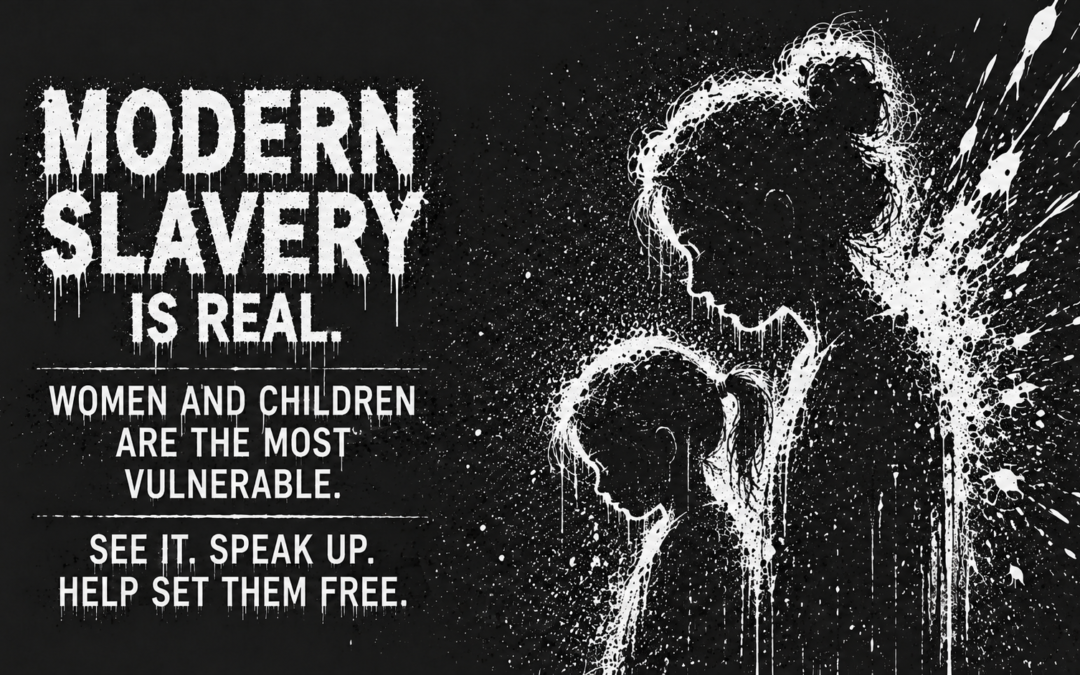
Slavery did not disappear. It changed its appearance.
There may be no visible chains. There may be no public auction blocks. Yet around the world, millions of human beings are still being controlled, exploited, threatened, trafficked, forced to work, or forced into marriages they did not choose.
Behind many of those numbers are women and children whose freedom has been taken from them.
According to Walk Free's Global Slavery Index, an estimated 50 million people were living in modern slavery on any given day in 2021. Approximately 27.6 million were in forced labour and 22 million were living in forced marriages. More than 12 million were children, while women and girls represented 54 percent of people living in modern slavery.
These are staggering numbers.
But we must remember that they are not merely numbers.
They are people.
They are daughters. Mothers. Sisters. Sons. Children with dreams. Women who deserve autonomy over their bodies and futures. Human beings who deserve the same fundamental thing every one of us deserves:
Freedom.
What Is Modern Slavery?
Modern slavery is an umbrella term encompassing severe forms of exploitation, including forced labour, human trafficking and forced marriage.
It can exist when someone is manipulated, threatened, deceived or coerced into a situation they cannot realistically refuse or escape.
Sometimes the control is physical.
Other times, the chains are psychological, financial or social.
A person's identification documents may be taken away. Their wages may be withheld. They may be threatened with violence, deportation or harm to their family. Someone may be trapped by debt, isolated from people who could help, or manipulated into believing escape is impossible.
This is one reason modern slavery can remain hidden even when it is happening around us.
Why Women and Girls Are Particularly Vulnerable
Modern slavery affects people of every gender, but inequality and discrimination create particular vulnerabilities for women and girls.
Forced marriage is one striking example.
Women and girls account for approximately 68 percent of people in forced marriages. Walk Free's research also reports that family members are frequently responsible for coercion: 73 percent of people in forced marriages were forced to marry by their parents, with another 16 percent forced by other relatives.
This reminds us that exploitation does not always begin with a stranger.
Sometimes control can exist behind the doors of homes, families and communities.
Economic inequality can deepen that vulnerability. When women lack equal access to education, employment, property, financial resources or legal protection, escaping an abusive or exploitative situation can become considerably harder.
A woman without money, documents, safe housing or a support network may technically be "free" under the law while having very few realistic avenues of escape.
The Children Hidden Behind the Statistics
Perhaps one of the most disturbing realities is that more than 12 million people living in modern slavery are children.
Childhood should be a time for learning, imagination, play and discovering who you are.
For millions of children, exploitation steals that childhood.
Children may be pushed into forced labour, domestic servitude, commercial sexual exploitation, forced marriage and other forms of abuse. Some forms of exploitation are also difficult to capture fully in global estimates. Walk Free notes that the estimates do not encompass every form of modern slavery, including recruitment of children by armed forces and all child marriages.
This means even horrifying global statistics may not reveal the entire picture.
Children are particularly vulnerable because they depend on adults for food, shelter, protection and survival.
A child cannot simply "walk away" from exploitation in the same way we might imagine an independent adult could.
When the very people or systems responsible for protecting a child become sources of exploitation, escape becomes even more difficult.
Poverty, Conflict and Displacement Create Fertile Ground for Exploitation
Modern slavery does not exist in isolation.
It thrives where vulnerability grows.
Conflict can destroy homes, separate families and weaken the institutions people depend upon for protection. Poverty can leave families desperate for income. Migration can place people in unfamiliar countries where they may not understand their rights or speak the language.
Climate pressures, economic instability, disrupted education and forced migration can further increase vulnerability.
Walk Free reports that the number of people living in modern slavery increased by approximately 10 million between 2016 and 2021. The organization points to overlapping crises, including conflict, environmental degradation, economic disruption, extreme poverty and unsafe migration, as factors that can heighten vulnerability to exploitation.
When people become desperate, predators often recognize opportunity.
A promise of employment can become forced labour.
A promise of transportation can become trafficking.
A promise of marriage can become control.
A promise of a better life can become a nightmare.
Modern Slavery Is Not Just "Somewhere Else"
One of the most dangerous misconceptions is believing modern slavery exists only in impoverished or developing countries.
It does not.
According to the Global Slavery Index, modern slavery occurs in every country, regardless of wealth. More than half of forced labour and approximately one-quarter of forced marriages are found in upper-middle-income or high-income countries.
That changes the conversation.
Modern slavery is not simply a problem happening somewhere far away.
It can exist within agriculture, domestic work, manufacturing, construction, hospitality and other industries. It can hide within global supply chains and behind ordinary products and services.
The person experiencing exploitation may be closer than we think.
The Hidden Cost of What We Consume
Modern slavery also forces us to ask uncomfortable questions about the global economy.
Who made our clothes?
Who harvested the ingredients in our food?
Who extracted the minerals used in our electronics?
Who performed the labour behind the products arriving at our doors?
Consumers cannot realistically investigate every individual worker behind every purchase. Governments and corporations therefore carry an enormous responsibility to ensure that exploitation is not embedded within supply chains.
Walk Free warns that interconnected global supply chains increase exposure to exploitation and argues that stronger accountability is necessary to eliminate these hidden forms of slavery.
Cheap goods can sometimes carry a human cost that never appears on the price tag.
Why "Just Leave" Is Not an Answer
When discussing exploitation, trafficking or abusive relationships, people sometimes ask:
Why didn't they just leave?
But freedom is much more complicated when another person controls the conditions of your survival.
Imagine having no money.
No identification.
No safe home.
No transportation.
No knowledge of the local language.
No family nearby.
Now imagine being told that if you leave, you will be arrested, deported, harmed, or someone you love will suffer.
Suddenly, "just leave" doesn't sound so simple.
Understanding coercion requires us to stop judging people from the comfort of circumstances they may never have had.
Freedom Requires More Than Rescue
Ending modern slavery cannot simply mean removing someone from an exploitative situation.
Survivors may need safe housing, medical care, psychological support, education, employment, legal assistance, financial resources and long-term protection.
Without those foundations, vulnerability can continue.
Walk Free notes that while more countries have criminalized forced marriage, many governments still lack a comprehensive response addressing underlying causes and survivor needs such as safe accommodation, emergency financial assistance, civil protections and psychosocial support.
Freedom must therefore mean more than opening a door.
It must mean giving someone the resources and power to walk through that door and build a life beyond it.
What Must Change
Governments must strengthen and enforce laws against trafficking, forced labour and forced marriage.
Businesses must examine their supply chains instead of benefiting from willful ignorance.
Communities must challenge traditions and social structures that treat women and girls as possessions rather than autonomous human beings.
Education must help children recognize exploitation and understand that their bodies and futures belong to them.
Survivors must be listened to when policies and programs are created.
And as individuals, we can educate ourselves, support credible anti-slavery organizations, question companies about supply-chain transparency, recognize signs of exploitation and refuse to normalize systems that depend upon the powerlessness of others.
But there is something even deeper that must change.
We must stop measuring human worth by usefulness, productivity, gender, poverty, immigration status or social position.
No Human Being Is Property
At its core, slavery begins with a devastating belief:
That one human being has the right to control another.
Everything else grows from there.
When women are treated as commodities, exploitation becomes easier.
When children are treated as labour instead of human beings with rights, exploitation becomes easier.
When poverty makes someone's suffering invisible, exploitation becomes easier.
When consumers care more about low prices than the people producing what they buy, exploitation becomes easier.
When society looks away, exploitation becomes easier.
Modern slavery survives partly because so much of it remains unseen.
That is why awareness matters.
Not awareness that lasts for five minutes after reading a statistic, but awareness that changes how we see other human beings.
Their Freedom Is Our Responsibility
Fifty million people are living in modern slavery, including more than twelve million children and millions of women and girls. The scale of this injustice can feel overwhelming, but enormous injustices have always depended, in part, on ordinary people believing there is nothing they can do to create change. There is. We can refuse indifference, demand accountability, support organizations fighting exploitation, listen to survivors, teach young people about consent, boundaries, and human rights, and challenge the systems that make vulnerable people easier to exploit.
And above all, we can continue saying something that should never need to be said, yet must be repeated until slavery truly belongs to history:
No woman is property.
No child is property.
No human being was born to be owned, controlled, bought, sold or exploited.
Freedom is not a privilege reserved for the fortunate.
Freedom is a human right.
Source & Further Reading
This article draws on findings from Walk Free's Global Slavery Index, including its global estimates and research on forced labour, forced marriage, children, women and girls.
Walk Free — Global Findings on Modern Slavery
If you believe someone may be experiencing trafficking or exploitation, contact appropriate local authorities or a reputable anti-trafficking organization in your country. When there is immediate danger, contact local emergency services.