
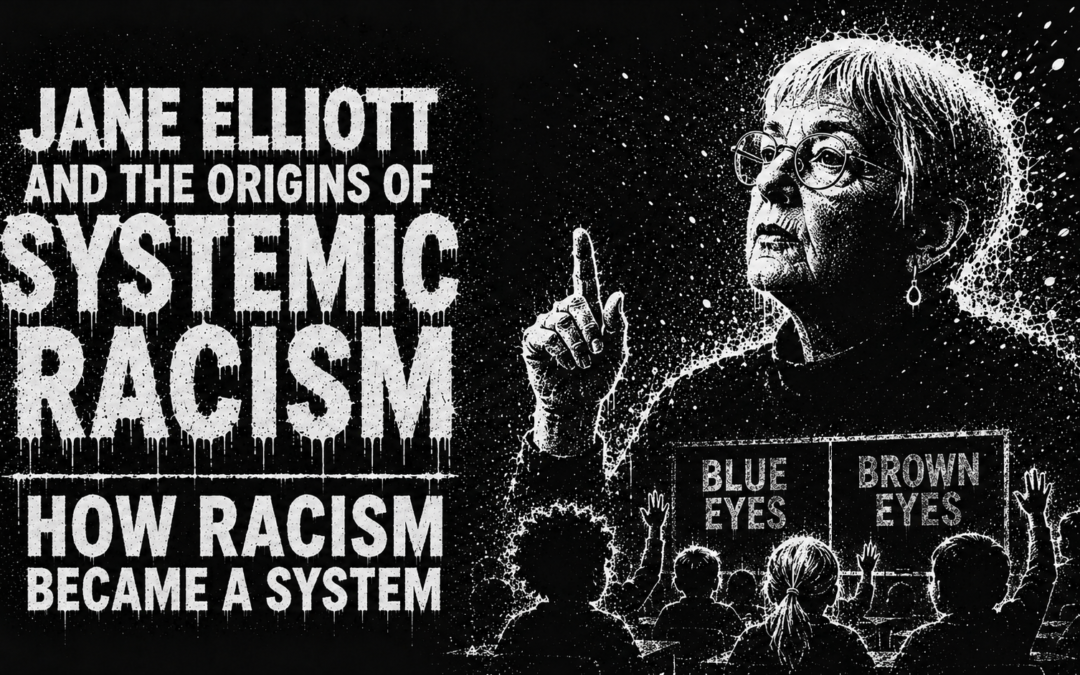
When educator Jane Elliott talks about racism, she often makes one important point: racism is not a natural human condition. It is something people created, taught and built into society.
Elliott became internationally known for her Blue Eyes Brown Eyes exercise, which she first conducted with her third grade students in 1968 after the assassination of Dr. Martin Luther King Jr.
By separating children according to eye color and temporarily giving one group privileges over another, Elliott demonstrated how quickly discrimination can affect behavior, confidence, performance and relationships.
But her larger message goes far beyond one classroom experiment.
Elliott has spent decades arguing that the idea of separate human races was used to justify unequal treatment and maintain social and economic power.
Jane Elliott on the Myth of Race
In a 2018 interview with Arizona PBS, Elliott made a powerful statement:
“We invented the myth of racism. There is only one race on the face of this earth.”
Her argument is that human beings created racial classifications and then attached ideas of superiority and inferiority to those classifications.
Once those beliefs became connected to laws, institutions, wealth and political power, racism became more than individual prejudice.
It became systemic.
How Did Systemic Racism Develop in America?
There was no single day when systemic racism suddenly appeared in America.
Instead, racial inequality developed over decades as colonial governments created laws that increasingly separated Europeans, Africans and Indigenous people.
One important example comes from colonial Virginia.
During the seventeenth century, European indentured servants and African laborers sometimes worked under overlapping systems of servitude. Their experiences were certainly not identical, and slavery already existed, but the racial boundaries that would later define American slavery were still developing.
Over time, those boundaries became much more rigid.
Historical records show that as early as 1640, Virginia courts were already treating African and European servants differently.
In the famous case of John Punch, three servants escaped together. The two European servants received additional years of service as punishment. John Punch, an African man, was sentenced to serve for the remainder of his life.
This is one of the early examples of racial differences being formally reflected in colonial law.
Bacon’s Rebellion and the Growth of Racial Division
Another major turning point came with Bacon’s Rebellion in 1676.
The rebellion was a complicated political and economic conflict in colonial Virginia. Poor European settlers, indentured servants, enslaved Africans and members of the colonial elite became involved in the uprising.
The rebellion also included brutal attacks against Indigenous communities, so it should not be remembered simply as a unified working class movement.
However, its aftermath is important to understanding the development of racial hierarchy.
During the following decades, Virginia created increasingly rigid distinctions between people of European and African ancestry.
Laws restricted the rights of Africans and their descendants while Europeans increasingly received legal and social advantages associated with being white.
Race was becoming connected to freedom, property, political participation and social status.
Racism Became More Than Personal Prejudice
This history helps explain the difference between prejudice and systemic racism.
A person can hold racist beliefs.
A system can do something much larger.
When racial distinctions influence laws, housing, education, employment, voting, policing, lending or access to wealth, discrimination can continue even when an individual person claims not to be prejudiced.
Jane Elliott addressed this distinction in a PBS interview when she explained that racism was not limited to obvious acts such as white supremacist violence.
She pointed instead to practices involving voting, housing, education, incarceration and financial redlining as examples of racism operating through institutions.
That is an important part of understanding systemic racism.
The Economic Side of Racism
Elliott has also connected racism with economics.
In a 2020 interview, she described racism as “profit making behavior.”
That statement raises an important question:
Who benefits when people are divided?
Throughout American history, racial hierarchy has frequently existed alongside economic hierarchy.
Enslaved labor generated enormous wealth.
Later discriminatory housing policies affected who could purchase homes and accumulate property.
Employment discrimination affected income.
Unequal access to education affected economic opportunity.
Racial inequality therefore cannot be understood only as a problem of individual attitudes.
It also has a material history.
Why Jane Elliott’s Blue Eyes Brown Eyes Exercise Still Matters
Elliott's classroom experiment demonstrated something surprisingly simple.
The children did not need generations to learn discrimination.
They needed an authority figure to tell them that one group was superior.
Once Elliott established the hierarchy, the favored children received privileges while the other children experienced discrimination.
The exercise was not intended to recreate the actual experience of racism. A temporary classroom exercise cannot reproduce generations of slavery, segregation or institutional discrimination.
Instead, it demonstrated how quickly arbitrary differences can acquire social meaning when authority, privilege and consequences are attached to them.
Racism Has to Be Taught
Perhaps the most important lesson from Jane Elliott's work is that racial superiority is learned.
Children are not born understanding racial hierarchies.
Societies teach people which differences supposedly matter.
Institutions can then reinforce those beliefs.
That means dismantling systemic racism requires more than simply telling people not to hate one another.
It requires understanding the history, laws, policies and institutions that allowed racial inequality to become embedded within society.
Understanding the Past Helps Us Recognize the Present
Jane Elliott did not invent the discussion about systemic racism, nor can the history of racism be reduced to one person, law or historical event.
But her work helped generations of people understand an important distinction.
Race may be a social construction, but the consequences of racism are very real.
The history of colonial America shows how racial categories gradually became connected to laws, rights, labor and economic power.
Understanding that history does not require blaming people living today for actions committed centuries ago.
It requires recognizing how systems are created, how they survive and how they can be changed.
That may ultimately be one of the most valuable lessons of Jane Elliott's work.